To ensure the continous improvement and long term performance of our high quality battery stacks, the optimization of battery components is essential. The R&D team at INO-HUB Energy is focused on development new optimized prototype stacks to meet the increasing demands for high power and lifespan.
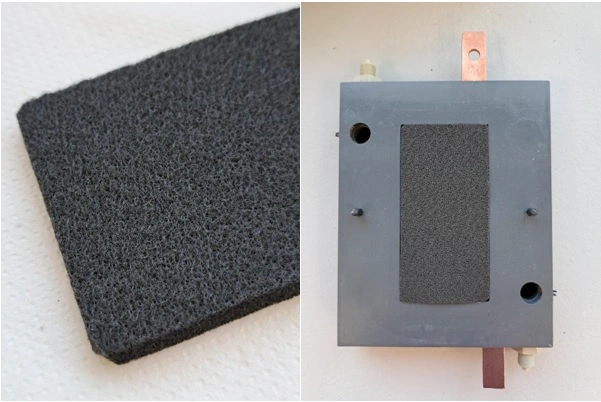
Before assembling these prototype stacks, selected materials must be throughly tested in laboratory cells. Among the evaluted components, this article is focused on carbon felts electrodes. These felt electrodes represent highly-porous graphite material which provide a large surface for electrochemical reactions to take place. Selecting a felt with sufficiently high electrochemical active surface area – ECSA, together with an appropiate and stable activation process leads to improvement on reaction kinetics of vanadium redox couples increasing the overall battery power.
In our laboratory, different commercially available electrodes were tested. The reproducibility of results is ensured by testing sufficient numbers of cells and following our standarized laboratory procedures. Dry Cell resistance is determined using Electrochemical Impedance Spectroscopy (EIS) on dry cells without ion exchange membrane. The testing protocol of complete laboratory cells includes impedance measurements at 0% and 50% state of charge (SOC), polarization curves measurements and extended cycling tests.
Low and stable resistance values, without significant increase through time of testing, indicate a high-quality and homogeneous electrode material. By comparing capacity utilization and charge/discharge efficiencies over multiple cycles, the evaluation of the materials and their impact on cell performance is studied.. The results of laboratory testing are crucial for selecting the most optimal electrode for our prototype battery stacks.
ACKNOWLEDGEMENT:
This work was supported by the project: IPCEI_IE_FLOW_BESS_012021_2.Phase