All-Vanadium Redox Flow Batteries (VRFBs) are among the most promising technologies for large-scale energy storage. One of their key advantages is that both sides of the battery use vanadium species: V²⁺/V³⁺ on the negative side and V⁴⁺/V⁵⁺ on the positive side. This unique configuration helps reduce the impact of electrolyte degradation and enables the electrolyte capacity to be recovered through rebalancing, including by mixing the electrolytes from the two tanks when appropriate.
Despite this advantage over other flow battery technologies, such as aqueous organic redox flow batteries and systems based on other metal or non-metal redox couples, the electrolyte represents a significant share of the overall VRFB project cost. Moreover, electrolyte purity can have a major influence on battery performance. Impurities may affect the kinetics of electrochemical reactions and the transport of vanadium species, while also promoting undesirable side reactions such as hydrogen evolution.
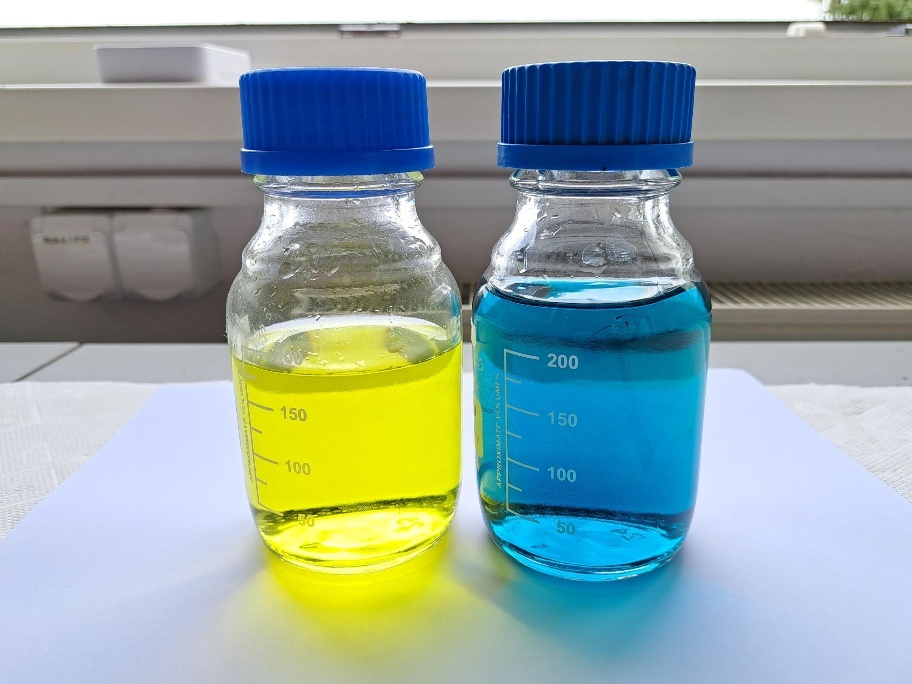
In this context, the INO-HUB R&D team, in collaboration with a Slovak chemical industry partner, is investigating different chemical and electrochemical approaches for the production of vanadium electrolyte. This multidisciplinary team is working to develop cost-effective production processes that deliver electrolyte with the required chemical composition and purity, while avoiding unnecessary production costs associated with additional purification steps.
The influence of the vanadium pentoxide (V₂O₅) source on vanadium electrolyte quality is receiving increasing attention from vanadium producers. V₂O₅ is extracted from a variety of mineral sources worldwide, and the composition of these feedstocks can directly affect the concentration and nature of impurities in the final vanadium electrolyte. Therefore, this study aims to evaluate V₂O₅ powders obtained from different mineral sources and assess their influence on the resulting electrolyte composition and impurity levels.
Once produced, the electrolyte is evaluated using IH laboratory cells at R&D centre. Its electrochemical performance is assessed during battery cycling, with particular attention paid to side reactions and overall stability. The results are then compared with those obtained using commercially available electrolytes.
Through this work, INO-HUB is contributing to the development of more cost-effective and reliable electrolyte production processes, supporting the continued advancement of VRFB technology for large-scale energy storage applications. This new process will place INO-HUB in an advantageous position on the VRFBs field.
ACKNOWLEDGEMENT:
This work was supported by the project: IPCEI_IE_FLOW_BESS_012021_2.Phase