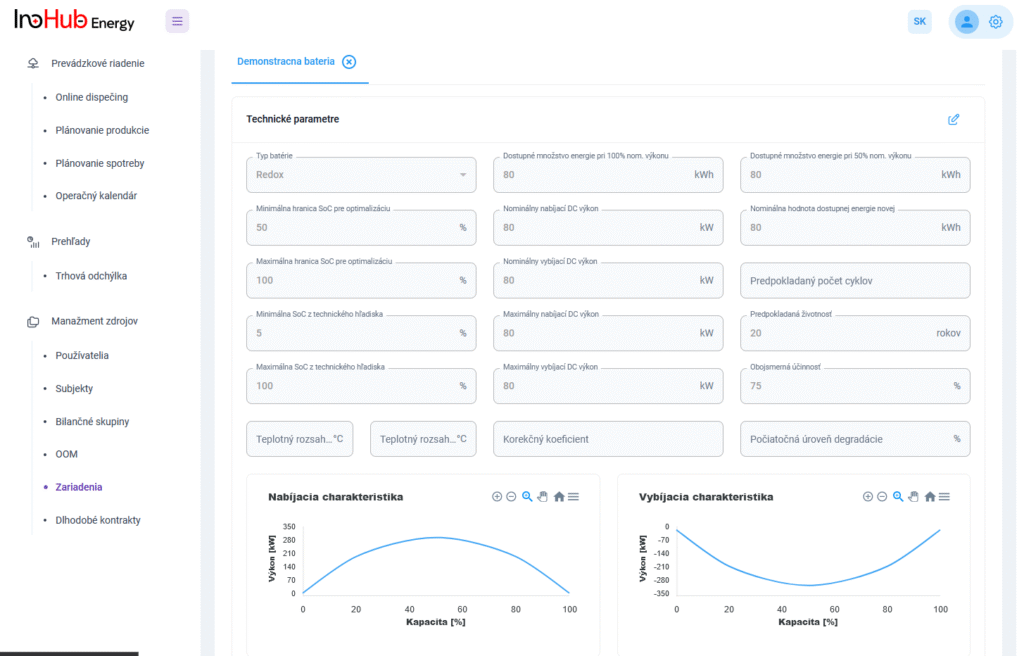
To select the most suitable membrane which is crucial component for development of efficient and reliable vanadium redox flow battery (VRFB) at INO-HUB Energy, we are testing commercially available membrane samples.
The first step in the qualification process is to evaluate the membranes in laboratory-scale cells. To compare the different membranes, measurements are conducted using identical single cells that differ only in the membrane used.
We have developed a testing procedure that includes the measurement of the following key membrane properties relevant to vanadium redox flow batteries:
- Ionic conductivity/resistance
- Selectivity/vanadium crossover
- Volume transfer
- Stability during cycling
Resistance affects the voltage efficiency of the battery. It is characterized by using electrochemical impedance spectroscopy (EIS) and by recording polarization curves during both charging and discharging. In addition, standard cycling tests are performed to determine the voltage efficiency of the cell.
Vanadium crossover results in a loss of Coulombic efficiency. It can also cause a concentration imbalance between the positive and negative electrolytes, leading to a loss of capacity. Coulombic efficiency is calculated from the cycling data, while the concentration imbalance is determined by titration of electrolyte samples taken periodically during cycling.
Net volume transfer during cycling is determined by measuring the weight of the electrolyte tanks before and after the cycling procedure.
To evaluate membrane stability, the electrolyte is remixed and the electrolyte levels in the tanks are balanced after a defined number of cycles. The EIS measurement and polarization curves are then repeated, followed by additional cycling. The resulting data are compared with the initial measurements to assess changes in performance over time.
ACKNOWLEDGEMENT:
This work was supported by the project: IPCEI_IE_FLOW_BESS_012021_2.Phase